Rolly Legs
- 4.4
- Rating
- 10.00M
- Installs
- Free
- Price

 Analysis by App-foxy
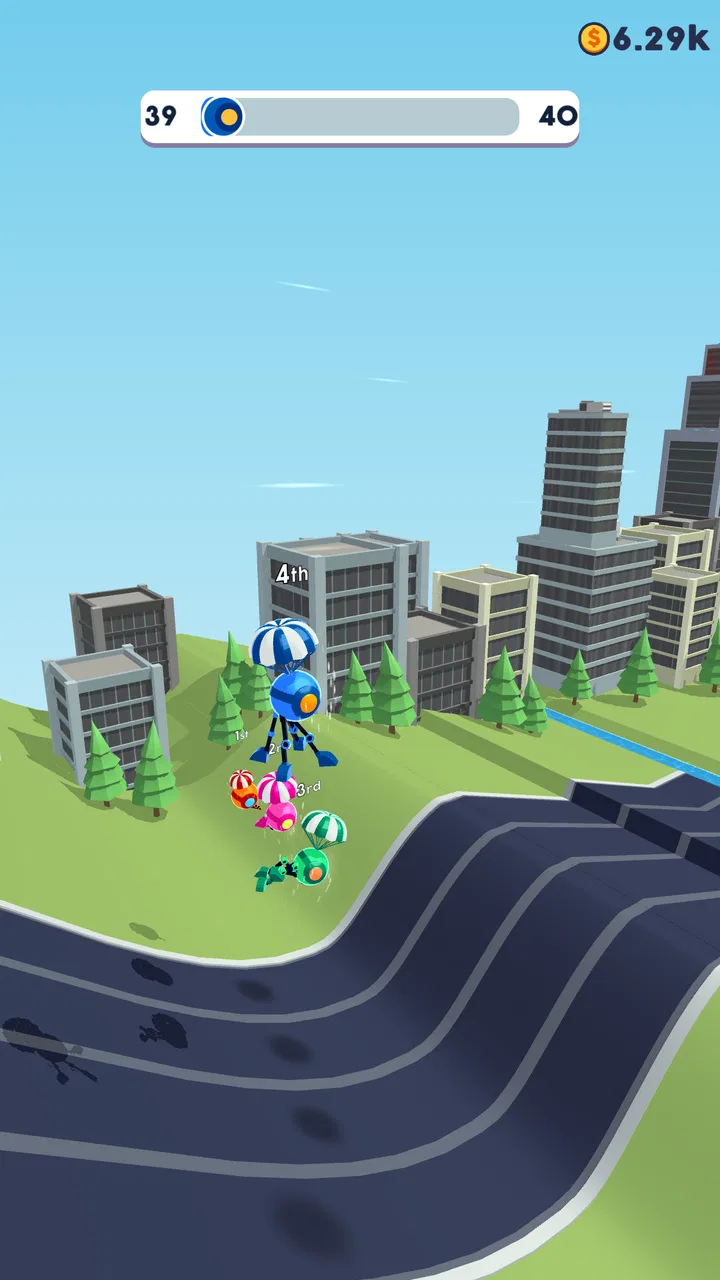
I went into Rolly Legs expecting a quick arcade distraction, and that is exactly where it works best. The idea is easy to understand: guide a small robot through a course by making it roll, walk, and climb, while trying to reach the finish without losing control. The first action takes almost no explanation, but the movement has enough awkwardness and momentum to make each attempt feel more involved than a simple tap-to-win game.
That balance is the main reason I kept returning to it. A round can begin as something to fill a spare minute, then turn into a sequence of “one more try” attempts when a mistake happens just before the goal. It is a free arcade game from VOODOO, rated for Everyone, and its broad appeal is easy to understand: there is no complicated story, character roster, or long tutorial to get through before the action starts.
How the first action feels in practice
The opening moments are deliberately simple. I control the robot through changing terrain, switching between rolling and more careful movement as the course demands. That simplicity is useful because I can pick up the game without studying controls, but it also places all the responsibility on timing. There is no large collection of buttons to hide behind. If the robot approaches an obstacle badly, the result is usually clear: I made the wrong movement at the wrong moment.
You May Also Like

 Blood Strike: 2.5 Anniversary
Blood Strike’s Loadouts Turn Every Drop Into a Tactical Gamble
A close look at Blood Strike’s custom loadouts: how fast access to signature weapons reshapes its battle royale rhythm, rewards preparation, and narrows the gap between fights.

 Pandora - Music & Podcasts
Pandora’s Music Is Easy to Start, but Harder to Recover
Pandora’s strength is its low-effort path from a seed to a station. Its weak spot is how much confidence it asks you to place in connection, setup, and quiet recovery.

 8 Ball Pool
 Is Built on Rivalries, Rematches, and Routine
A close look at the rivalries, rematches, shared routines, and unanswered safety questions that turn a quick pool match into a persistent mobile community.

 Samsung Music
’s Quiet Strength Is Playing What You Already Own
Its reach comes less from spectacle than from dependable access to a personal library. That simplicity is both the app’s strongest retention engine and its ceiling.

 AccuWeather: Weather Radar
AccuWeather Review: A Quick, Clear Forecast for Everyday Decisions
For everyday plans, the best forecast is the one you can understand quickly. AccuWeather makes rain timing, radar, and local conditions easy to act on, with a few trade-offs.

 Hill Climb Racing
Why Hill Climb Racing Still Turns Crashes Into One More Run
A tiny car, a bumpy hill and one more upgrade: Hill Climb Racing keeps resurfacing because its simple chaos makes every near-miss feel personal.
More From Our News Desk



What makes the first action satisfying is the physical feedback. The robot does not feel like a symbol sliding along a track. Its movement has a playful, slightly unpredictable quality, so a slope or climb asks me to react rather than simply follow a memorized route. I quickly learned that holding a movement too long can be just as damaging as failing to act. The best runs come from short corrections, not from constantly forcing the robot forward.
This is also where the game separates itself from the most basic arcade games. A typical endless tap game often asks for one repeated gesture and measures how long I survive. Here, the interest comes from managing a little machine with different ways of moving. Rolling is useful for speed, walking gives me more control in awkward places, and climbing changes the pace again. The course becomes a small problem to solve rather than just a line to endure.
I would not describe the controls as perfectly precise in every situation. That is partly intentional, because the loose movement creates funny recoveries and unexpected failures. Still, players who want exact platforming may find the robot’s behavior frustrating. The game is more comfortable with playful physics than with tournament-level accuracy. I had to accept that some attempts would end because my correction arrived slightly too late, even when I understood what I wanted the robot to do.
For a normal everyday use case, this makes sense during a short break, while waiting for a bus, or when I want something that starts immediately without demanding a long commitment. I can play with sound off and still understand the action from the visual movement. It is less suitable when I am looking for a deep evening game with a story, strategic planning, or a large sense of progression.
The feedback rhythm keeps the controls interesting
The strongest part of the experience is the rhythm between action and response. I make a movement, see the robot gain speed or lose balance, then adjust almost immediately. That quick exchange gives the game its character. Even when the course itself is visually simple, the robot’s response tells me whether I am building a good run or creating a problem that will soon become impossible to recover from.
I found it helpful to watch the robot’s posture instead of staring only at the next obstacle. If it starts approaching a climb at an awkward angle, the mistake may already be developing. Correcting earlier is usually safer than waiting until the front of the robot reaches the surface. This is one of the small lessons the game teaches without spelling it out: the most useful decision often happens before the obvious danger appears.
Another practical habit is to avoid treating speed as the only goal. Rolling quickly feels rewarding, but a fast approach can make the next transition harder. I had better results when I used a quick section to prepare for the slower section that followed. That changed the game from a frantic reaction test into a sequence of choices about when to preserve momentum and when to sacrifice it for control.
The feedback is especially effective after a near miss. When I barely recover from a bad angle, I immediately understand what saved the attempt and what I should repeat. A perfect run is not the only satisfying outcome; sometimes getting the robot over a difficult section after a clumsy start is enough to make the attempt feel worthwhile. That sense of recovery gives the game more personality than a purely binary success-or-failure design.
At the same time, the feedback loop can become repetitive for players who need constant novelty. The central pleasure remains movement through courses, so this is not a game I would recommend to someone who quickly tires of repeating a familiar physical challenge. Its appeal depends on whether small improvements in timing feel meaningful to you. I enjoyed refining my approach, but I can see another player reaching the limit of that interest sooner.
What counts as a reward here
The immediate reward is reaching the end of a course after controlling the robot through its awkward sections. That may sound modest, but it fits the short-session design. I do not need a complicated achievement system to understand why a successful attempt felt better than the previous one. The reward is partly progress and partly proof that I finally handled a movement that had caused trouble.
The game’s store presence reflects that accessible style. It is free to download, has passed the ten-million-install mark, and holds a 4.4 average from around 124 thousand ratings. Those figures suggest that the simple action has found a substantial audience, but they do not change my personal conclusion: the game is best judged by how much you enjoy repeating a compact movement challenge, not by its popularity alone.
There are in-app purchases priced at $3.49 per item. I would keep that in mind before handing the game to a child, even though the content rating is Everyone. The free entry point makes it easy to try, while the purchase option means I would still check device purchasing settings if a younger player were using it. For me, the important question is whether the basic play is enjoyable without feeling pressured to spend. The core appeal comes from controlling the robot, so I would try that experience first before considering any optional purchase.
The reward structure is also more personal than collection-driven. I did not play because I wanted to build a large inventory or manage a complicated profile. I played because I wanted to beat the section that had exposed my poor timing. That is a strength for people who prefer immediate action, but a weakness for anyone who needs visible long-term goals to stay motivated.
One useful way to approach the game is to set a tiny objective for each session. Instead of demanding a flawless run, I might focus on entering a climb with better balance, or on using less frantic corrections during a rolling section. That turns a failed attempt into information. The game becomes more rewarding when I measure improvement against my own previous movement rather than expecting every round to end perfectly.
Why the reset makes another session tempting
The reset is central to the design. When a run ends, the disappointment is usually brief because I already know what I want to change. The restart is not asking me to rebuild a character, replay a long story segment, or wait through a complicated setup. I can return to the action and test a different approach almost immediately, which is why a short session can quietly become several attempts.
This reset works because the failure is readable. If I miss a climb or approach a transition with too much speed, I can connect the mistake to a decision. That connection matters. A reset feels fair when I understand what happened, and Rolly Legs generally gives me enough visual information to make that judgment myself. The game does not need a long explanation after every failure because the robot’s movement already shows the problem.
There is a trade-off, though. Fast resets are excellent for momentum, but they can also encourage unthinking repetition. I caught myself restarting with the same timing and expecting a different result. The better habit is to pause mentally for a moment and identify one change before trying again. Even a small adjustment, such as slowing down before a climb, makes the next run feel like an experiment rather than a duplicate.
This is where the game fits casual players particularly well. If I only have a few minutes, I can still experience the full action-feedback-reset cycle. If I have longer, I can use repeated attempts to improve control. The same structure serves both situations, although it does not offer the depth of a full platformer or the strategic variety of a more elaborate arcade title.
I would skip it if I wanted a calm game with no failure pressure. Although the controls are approachable, the repeated resets can become irritating when I am tired or distracted. I would also choose a different game if I wanted multiplayer competition, narrative development, or a broad selection of modes. This is a focused experience, and its focus is both its appeal and its limit.
Where it sits among familiar arcade alternatives
Compared with a standard endless runner, Rolly Legs feels less automatic because the robot’s movement asks for more active correction. I am not simply changing lanes or reacting to one obvious prompt. The rolling, walking, and climbing behaviors create a more physical relationship with the course. The trade-off is that the game may feel less immediately smooth than an endless runner designed around a single, highly polished gesture.
Compared with a traditional platformer, it is much lighter. I do not approach it for carefully designed exploration, character abilities, or a substantial world. Its courses are there to create compact tests of control. That makes it easier to start and easier to abandon without losing a large block of progress, but it also means the experience may not satisfy players who want discovery and mastery across a long campaign.
It also differs from puzzle-focused arcade games. The decisions are physical and moment-to-moment rather than based on arranging objects or planning several moves ahead. I can think about the next transition, but the final result depends on how the robot responds while moving. For me, that gives the game a more playful feel than a strict logic challenge, though players who prefer predictable solutions may find the physics less comfortable.
The game runs on Android 8.0 or later, and the current version is 3.02. That makes the compatibility requirement fairly approachable for many Android users. I would still check the device before installing, especially if I were setting it up on an older phone. The important practical expectation is that this is a quick arcade title rather than a large, content-heavy download experience in the way a major console-style mobile game might be.
VOODOO’s role as developer also fits the game’s compact presentation. The design gets to its central interaction quickly and does not bury the robot under layers of menus. That economy is welcome when I want instant play, although it leaves less room for players who expect extensive customization or a long-term progression framework.
Small techniques that improved my runs
My first useful adjustment was to think in transitions rather than isolated obstacles. I stopped asking only, “How do I get over this?” and started asking, “What movement do I need immediately after this?” A successful climb can still create a poor landing for the next section. Preparing for the following movement made my runs more consistent than reacting only when the next problem was already underneath the robot.
The second was to use restraint during fast sections. My instinct was to keep the robot moving aggressively, but that often left me with too little time to correct the approach to a climb. Letting the robot settle before a technical section felt slower, yet it usually produced a better chance of continuing. This is a useful trade-off for new players: the quickest visible route is not always the quickest route to the finish.
The third was to treat failed runs as short tests. I changed one behavior at a time instead of trying to alter everything at once. If I changed speed, timing, and direction together, I could not tell what had helped. Keeping the experiment narrow made the feedback clearer and gave each restart a purpose. That approach is especially valuable when the game begins to feel repetitive.
I also found that the game works better in focused bursts than as background entertainment. Because the robot’s posture and momentum matter, splitting attention between the course and another task makes mistakes feel random. A short, deliberate session is more enjoyable than a longer distracted one. This is not a demand for silence or perfect concentration, but it does reward looking at the movement rather than playing purely by habit.
Who should try it, and who should pass
I would recommend it to someone who likes quick arcade challenges, playful physics, and the satisfaction of improving through repetition. It is a good fit for a friend who wants something immediately understandable but still wants more interaction than a passive time-killer. Younger players can grasp the basic idea quickly, while older players may enjoy chasing cleaner movement through familiar types of obstacles.
I would be more cautious recommending it to someone who dislikes trial and error. The game’s charm depends on accepting that a run may fail and using the reset to try again. If every restart feels like wasted time, the central loop will not have much to offer. Likewise, players looking for deep customization, story, multiplayer, or carefully controlled platforming should choose a different arcade experience.
The free price removes the biggest barrier to trying it, but the optional $3.49 purchases still make it sensible to review purchasing controls on a shared device. I would install it for a quick test rather than promising myself a long-term game. Within a few rounds, it becomes clear whether the robot’s loose movement feels amusing or annoying to you.
Its Everyone rating makes the tone broadly approachable, and the absence of a complicated premise helps it work as a casual family-friendly option. Even so, I would not assume every player will enjoy the same thing. A child may love the rolling robot, while an adult who wants precise control may quickly notice the physics-based looseness. The right audience is defined less by age than by tolerance for imperfect, repeatable movement.
My verdict on the complete action loop
Rolly Legs succeeds because its loop is easy to feel: I take an action, watch the robot respond, learn from the result, reach a small reward when the run works, and reset when it does not. The next session begins because the previous failure usually leaves behind one clear question: what if I approach that section differently? That is a stronger reason to replay than a generic promise of endless entertainment.
It is not a deep arcade game, and I would not pretend that its simple structure will hold everyone’s attention indefinitely. The loose controls can frustrate players who want exact platforming, and the repeated course challenge may feel narrow beside larger mobile games. But within its chosen scale, the design is coherent. The robot’s movement, the immediate feedback, and the quick restart all support the same purpose.
After spending time with it, I see it as a good free choice for short breaks and casual sessions, especially when I want action without preparation. The most rewarding way to play is to focus on one improvement per attempt, preserve control before climbs, and judge progress by cleaner decisions rather than only by reaching the finish. If that sounds satisfying, this compact arcade game is worth trying. If you need story, variety, or precision above all else, I would look elsewhere.
My final recommendation: try it when you want a friendly but slightly mischievous movement challenge, not when you are searching for a complete long-form game. The reason another session begins is simple and effective: the robot almost made it, and I usually want to see whether a better decision can turn that near miss into a successful run.
FAQs for Rolly Legs
01What is Rolly Legs and how does the gameplay work?
Rolly Legs is a casual arcade game in which you control a rolling character that moves along obstacle-filled tracks. The main challenge is switching between rolling and extending legs at the right moment. Legs help your character climb slopes and uneven surfaces, while rolling is generally faster on flat sections. Each level requires timing, quick reactions, and careful movement to avoid obstacles and reach the finish line.
02Is Rolly Legs free to download and play?
Rolly Legs is generally available as a free-to-download game on supported mobile devices. However, the free version may include advertising and optional in-app purchases. These purchases can sometimes provide cosmetic items or other extras, but they are not normally required to complete the basic levels. Before downloading, users should check the store listing for the current pricing, advertisements, and regional availability.
03Does Rolly Legs require an internet connection?
Rolly Legs is designed as a simple pick-up-and-play experience, so many of its core levels can usually be enjoyed without a constant internet connection. That said, an internet connection may be needed to display advertisements, access certain online features, download updates, or restore purchases. Offline behavior can vary depending on the device and app version, so it is best to test the game after installation.
04Is Rolly Legs suitable for children?
Rolly Legs uses simple controls, colorful visuals, and straightforward arcade gameplay, making it accessible to a wide range of players, including children. Nevertheless, parents should review the age rating and privacy information because the game may contain advertising or optional purchases. Younger players may also need supervision to prevent accidental purchases and to manage the amount of time spent playing.
05What are the main advantages and disadvantages of Rolly Legs?
The main advantages of Rolly Legs are its easy controls, short levels, amusing physics, and gameplay that is simple to understand but still rewards good timing. It works well for quick gaming sessions and does not require extensive experience. On the other hand, the experience may become repetitive for some players, and advertisements or optional purchases can affect enjoyment. Its appeal depends largely on whether you like casual obstacle games.
Pros
- Simple one-touch controls are easy for players of almost any age.
- Short levels make it convenient for quick gaming sessions.
- The rolling movement feels responsive and satisfying to master.
- Colorful visuals and playful animations give the game a cheerful style.
- It is free to download and easy to start without a lengthy tutorial.
Cons
- Frequent ads can interrupt the experience
- especially after completing levels.
- Gameplay may feel repetitive once the basic rolling mechanic is mastered.
- Later obstacles can seem more dependent on timing than genuine skill.
- Limited customization reduces the incentive to keep playing long term.
- Some levels offer little challenge for experienced arcade game players.

Rolly Legs
Gallery